TALK TO AN EXPERT !

+91 8149903092

Edit Content

Disclaimer

Important Notice :- JusticeHub is NOT a law firm and does NOT provide legal representation. All information and guidance provided is for educational and awareness purposes only.
1. No Legal Advice

The information provided on JusticeHub does not constitute legal advice. While we strive to provide accurate and up-to-date information, we make no representations or warranties of any kind, express or implied, about the completeness, accuracy, reliability, or suitability of the information.

2. No Guarantee of Outcomes

JusticeHub does not guarantee any specific outcomes for cases or situations. The success of any legal or administrative action depends on many factors beyond our control. Past results do not guarantee future outcomes.

3. Professional Consultation

For specific legal matters, we strongly recommend consulting with a licensed attorney who can provide professional legal advice tailored to your specific circumstances. JusticeHub can help you understand your options, but final decisions should be made in consultation with qualified professionals.

4. User Responsibility

Users are solely responsible for their actions based on information received from JusticeHub. We encourage all users to verify information and seek professional advice before taking any significant legal or administrative action.

5. Ethical Use

JusticeHub promotes only lawful, ethical, and responsible action. We do not encourage, support, or assist in any illegal activities. All guidance provided is meant to help citizens navigate the system through proper and legal channels.

6. Contact

If you have questions about this disclaimer, please contact us at help@justicehub.help.
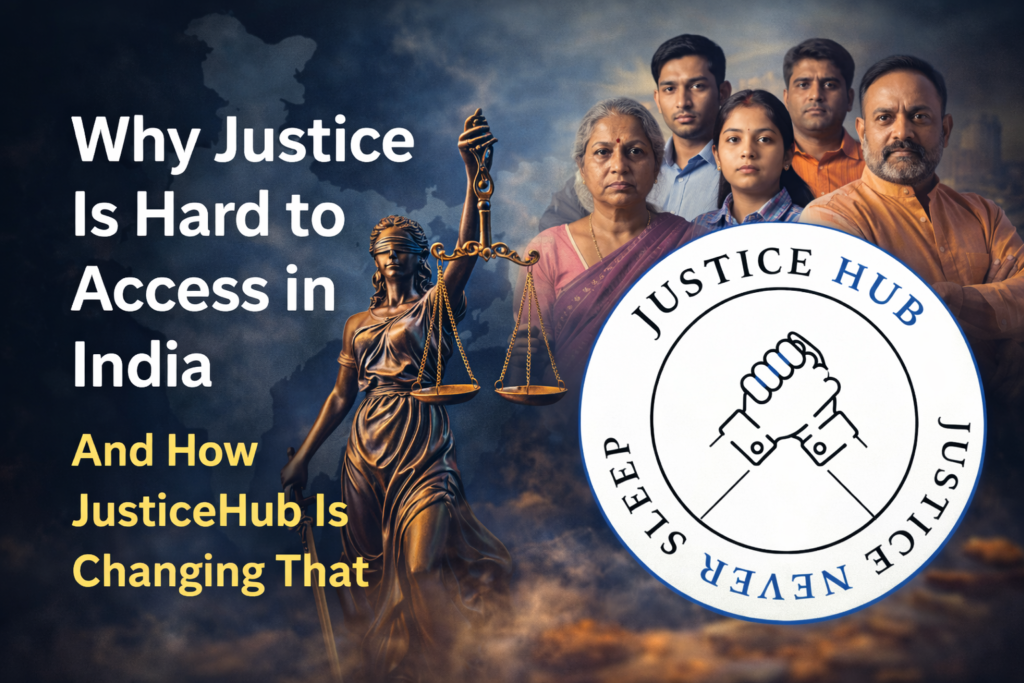
Why Justice Is Hard to Access in India – And How JusticeHub Is Changing That

Why Is Justice Hard to Access in India?

India has one of the largest judicial systems in the world, yet for millions of citizens, justice remains difficult to access. From delayed court processes to lack of legal awareness, many people struggle to protect their rights—even when the law is on their side.

The reality is simple: justice exists, but access does not reach everyone equally.


1. Lack of Legal Awareness Among Citizens

Most citizens do not know:

  • Where to file a complaint
  • How to use RTI (Right to Information)
  • What legal remedies are available
  • How to respond to harassment or unfair practices

As a result, people often give up before even taking the first legal step.


2. Complex and Time-Consuming Legal Procedures

Legal processes in India can feel overwhelming:

  • Multiple documents
  • Confusing procedures
  • Long waiting periods
  • Expensive legal consultations

For a common citizen, navigating the system alone becomes nearly impossible.


3. Fear, Cost, and Lack of Guidance

Many people avoid legal action due to:

  • Fear of authorities or institutions
  • High legal fees
  • No clear guidance or trusted support

This leads to injustice continuing silently—especially in cases involving consumers, employees, loan harassment, or denied public services.


How JusticeHub Is Making Justice Accessible

JusticeHub was created to bridge the gap between citizens and justice.
Our goal is simple: make legal help accessible, understandable, and actionable for everyone.


 Legal Awareness First

JusticeHub educates citizens about:

  • Their legal rights
  • Lawful actions they can take
  • Proper legal channels

Because awareness is the first step toward justice.


Guided Legal & RTI Support

We help citizens with:

  • RTI filing and follow-ups
  • Legal documentation support
  • Consumer complaints
  • Debt and recovery harassment guidance
  • Case understanding and lawful response

All through a structured, guided, and transparent process.


 Technology-Driven Access to Justice

JusticeHub uses digital tools to:

  • Reduce confusion
  • Simplify processes
  • Connect citizens with the right guidance

This saves time, reduces cost, and removes unnecessary barriers.


Citizen-First Justice Platform

Unlike traditional systems, JusticeHub focuses on:

  • Empathy
  • Simplicity
  • Lawful action
  • Transparency

Because justice should support citizens, not intimidate them.


Justice Should Not Be a Privilege

Justice is not meant only for those who:

  • Can afford expensive lawyers
  • Understand complex laws
  • Have influence or connections

JusticeHub believes that every citizen deserves access to justice, regardless of background.


Justice in India is powerful—but only when citizens can access it.

By combining legal awareness, guided support, and technology, JusticeHub is working toward a future where justice is not delayed, denied, or out of reach.